The JK Shah Journal

Expert insights, exam strategies, and the latest from the world of professional education.
What is ACCA? Full Form, Course Details, Fees and Syllabus
ACCA

What is ACCA? Full Form, Course Details, Fees and Syllabus

What is ACCA?


ACCA is a global professional accounting qualification, and it stands for the Association of Chartered Certified Accountants. That is the direct answer. Everything else about ACCA, the papers, the fees, the career outcomes, sits on top of that one fact.

But a definition rarely tells you why something matters. Every year, thousands of commerce students in India sit at kitchen tables deciding between CA, CS, CMA, and increasingly, ACCA. Most of them arrive at that decision with half information, usually a cousin's opinion or a coaching centre's brochure. Few pause to ask a simpler question: why has a UK-headquartered body become one of the most searched qualifications among Indian commerce students in the last decade?

Part of the answer is mobility. India's finance and accounting talent no longer works only for Indian companies reporting under Indian standards. Global Capability Centres, multinational audit firms, and companies that report under IFRS have created a demand for professionals who think in international frameworks from day one. ACCA was built for exactly that world.


What does ACCA stand for?


The Association of Chartered Certified Accountants. It was founded in 1904 in London and today has members and students spread across more than 180 countries, which is precisely why the qualification carries currency far beyond the country where it was created.


What is the ACCA qualification?


Strip away the acronym and ACCA is a structured, exam-based qualification in accounting, finance, audit, taxation and business strategy. It is built in three progressive levels, tests candidates through computer-based exams, and requires supervised practical work experience before a candidate can call themselves an ACCA member. It is not a degree in the conventional sense, though many universities now treat it as degree-equivalent for further study or employment purposes.


What is ACCA in India?


In India, ACCA functions as an internationally recognised alternative and, for many students, a complement to Indian qualifications like CA, CS and CMA. It does not replace the Indian CA for practising as a statutory auditor under Indian law, since that requires ICAI membership. What it does offer is a credential that is instantly understood by a multinational employer in London, Dubai, Singapore or Toronto, without the years of context-setting that a purely domestic qualification sometimes requires.


ACCA Full Form and Meaning


The ACCA full form is the Association of Chartered Certified Accountants, and there is genuinely nothing more hidden behind the letters. Students sometimes assume acronyms like this carry a longer, more technical meaning. This one does not. It is simply the name of the professional body that awards the qualification, in the same way the CFA Institute awards the CFA charter.

What does ACCA stand for in commerce, specifically? It represents a body of knowledge spanning financial accounting, management accounting, taxation, audit, law, financial management and strategic business leadership, assessed through a syllabus that is reviewed and updated by ACCA Global on a rolling basis to stay aligned with how finance actually gets practised, including areas like sustainability reporting and data-driven decision making that older qualifications have been slower to formally examine.


ACCA Course Overview


ACCA course details are best understood as a ladder, not a single exam. Candidates typically without exemptions work through 13 papers, though most Indian students carry some exemptions in from a prior degree, which shortens that number considerably. Alongside the exams, ACCA requires completion of an Ethics and Professional Skills Module and a Practical Experience Requirement, meaning candidates must log a minimum period, generally around 36 months, of relevant supervised work experience before they can become full members.

The ACCA course structure is organised into three qualification levels. Applied Knowledge lays the foundation in business, management accounting and financial accounting. Applied Skills builds technical depth across law, performance management, taxation, financial reporting, audit and financial management. Strategic Professional, the final and most demanding stage, asks candidates to think like decision makers rather than technicians, combining two compulsory papers with a choice of two from four specialist options.

So how many papers are there in ACCA? Under the current structure, it is 13 in total, three at Applied Knowledge, six at Applied Skills, and four at Strategic Professional. ACCA has already signalled a restructuring that will reduce this to 11 papers starting around late 2027, retiring one Applied Knowledge paper and reshaping the options structure, so students beginning now should confirm the applicable syllabus for their intake year directly with ACCA before finalising a study plan.


ACCA Course Duration


How many years does it take to complete ACCA is one of the most practical questions a prospective student can ask, and the honest answer is that it depends far more on effort and exemptions than on any fixed calendar. A highly disciplined student with no exemptions can, in theory, finish in under three years by clearing the maximum permitted exams per year. Most students, balancing study with college, articleship or a job, take closer to three to four years.

ACCA duration after 12th tends to run longer simply because a student is starting from the very first paper with no exemptions to shorten the road, and is often juggling undergraduate studies alongside ACCA preparation. ACCA course duration after graduation is usually shorter, because a B.Com or equivalent degree typically earns exemptions from several early papers, letting a graduate begin closer to the middle of the ladder rather than the start.


ACCA Eligibility Criteria


Is ACCA accessible after school, or does it demand a degree first? Both paths exist, and this is worth stating plainly because a lot of confusion in Indian households stems from assuming ACCA is only for graduates.

ACCA eligibility after 12th allows a student who has completed higher secondary school with a minimum aggregate, generally around 65 percent in two subjects including Mathematics or Accounts and English, along with a minimum overall percentage across other subjects, to register directly through the Foundation-level entry route. Can you do ACCA after 12th, then? Yes, and a meaningful proportion of ACCA students in India enter exactly this way, often studying ACCA alongside a B.Com degree so the two qualifications reinforce each other rather than compete for time.

ACCA eligibility requirements for graduates are more straightforward. A recognised bachelor's degree, particularly in commerce, accounting or finance, generally grants both direct entry and exemptions from a handful of papers, since the coursework already overlaps with ACCA's early syllabus.

Is Maths compulsory for ACCA? Not in a strict, standalone sense, but a working comfort with numbers is unavoidable, since papers like Financial Management and Performance Management are quantitative by design. A student who genuinely struggles with numerical reasoning would find the middle and later papers difficult regardless of the entry route chosen.


ACCA Syllabus and Subjects


The ACCA subjects list, or ACCA papers list, is where most of the anxiety around this qualification actually lives, largely because 13 papers sounds intimidating until you see how they are grouped.

Applied Knowledge covers Business and Technology, Management Accounting and Financial Accounting. These are on-demand computer-based exams, meaning a student can sit them almost any time of year rather than waiting for a fixed exam window, which is one of the more underrated conveniences of the ACCA structure compared to Indian professional exams that run on rigid biannual cycles.

Applied Skills is the widest band, with six papers: Corporate and Business Law, Performance Management, Taxation, Financial Reporting, Audit and Assurance, and Financial Management. This is where the syllabus stops being introductory and starts resembling the actual work of a finance professional, interpreting financial statements, planning tax positions, evaluating investment decisions.

Strategic Professional consists of two compulsory Essentials papers, Strategic Business Leader and Strategic Business Reporting, followed by a choice of two papers from four Options: Advanced Financial Management, Advanced Performance Management, Advanced Taxation and Advanced Audit and Assurance. This level is entirely scenario-based, with no objective-test questions, because by this stage ACCA is testing judgement, not recall.

So how many subjects are there in ACCA in total? Thirteen, under the current structure, though a student with strong exemptions may only ever sit four to nine of them directly.


ACCA Fees in India


ACCA course fees are structured very differently from the one-time payment model most Indian students expect from domestic coaching institutes. ACCA charges in pounds sterling, and the total cost is really the sum of several separate charges rather than a single number, which is exactly why students who only Google "ACCA fees" often underestimate their real budget.

The ACCA registration fee is a one-time charge paid when a student first joins, currently reduced to around thirty pounds for eligible entrants in India, though the standard rate runs higher. On top of that comes the ACCA annual subscription fee, roughly one hundred and forty pounds every year a student remains registered, whether or not they sit an exam that year. Since most students take three to four years to finish, this alone adds up to a meaningful sum over the course of the qualification.

ACCA exam fees, or ACCA fees per paper, rise as a candidate climbs the three levels. Applied Knowledge papers are the least expensive, Applied Skills papers sit in the middle, and Strategic Professional papers, particularly Strategic Business Leader, are the most expensive of all. Entry timing matters too. Booking in the early window is meaningfully cheaper than booking late, a detail that catches out students who leave registration until the last fortnight before a session closes.

Putting it together, the total cost of ACCA in India, paid directly to ACCA across registration, subscription and all exam fees with no exemptions, typically lands somewhere between two and three lakh rupees. Add exemption fees for papers a student skips using a prior degree, and coaching or study material costs on top, and the realistic all-in figure for most Indian students, including structured tuition support, tends to fall between three and four and a half lakh rupees spread across the full duration of the course, not paid upfront.


ACCA Exam Structure and Pattern


The ACCA exam structure mirrors its three levels. Applied Knowledge exams are on-demand computer-based exams available through the year. Applied Skills and Strategic Professional exams run in fixed ACCA exam sessions, held four times a year, in March, June, September and December, with a cap on how many papers a candidate can attempt in a single window and across a calendar year.

The ACCA exam pattern shifts noticeably as candidates progress. Applied Knowledge relies heavily on objective-test questions. Applied Skills blends objective and written, scenario-based responses. Strategic Professional drops objective testing altogether in favour of long-form, case-study analysis, because that is closer to how a senior finance professional is actually expected to think and communicate.

ACCA passing marks are set at fifty percent for every paper, which sounds generous compared to some Indian professional exams, until you sit an actual Strategic Professional paper and realise that fifty percent under exam pressure, with multiple competing demands in a single scenario, is not a low bar at all.

This is where structured preparation genuinely earns its cost. An institute like JK Shah Classes, working across CA, CMA and ACCA cohorts, tends to build its paper sequencing and mock-exam calendar around exactly this session rhythm, so students are not left guessing which window to target for which paper.


ACCA Exemptions


What are ACCA exemptions, in plain terms? They are ACCA's way of recognising that a student has already covered certain syllabus content through a prior degree or professional qualification, and therefore does not need to sit that paper again. An exemption is not free, a fee is charged for each one, but it is almost always cheaper and faster than sitting the actual exam.

ACCA exemptions after B.Com typically cover the three Applied Knowledge papers along with one or two Applied Skills papers, depending on the specific university and syllabus the degree was completed under, since ACCA assesses course content rather than simply the degree title. ACCA exemptions for CA students scale with how far a candidate has progressed. Clearing CA Intermediate generally unlocks around five to six exemptions, while a fully qualified Chartered Accountant can receive exemptions on all nine Applied Knowledge and Applied Skills papers, entering ACCA directly at the Strategic Professional level with only four papers left to clear.

The genuinely useful tool here is the ACCA exemption calculator, available on ACCA's own website, where a student enters their exact degree and university to get a personalised exemption estimate rather than relying on generic averages that may not apply to their specific transcript.


How to Become an ACCA?


The ACCA registration process starts with creating an account on ACCA's official platform and submitting educational documents for verification, at which point ACCA also assesses and confirms any exemptions the candidate qualifies for. How to apply for ACCA in practice usually means completing this registration, paying the initial fee, and then mapping out a paper sequence, often with guidance from a tuition provider who understands typical pass-rate patterns across papers.

Steps to start ACCA after 12th look slightly different from the graduate route. A student registers using their higher secondary marksheet, gets assessed for the Foundation-level entry criteria, and begins directly with the Applied Knowledge papers, since there are no prior exemptions to claim at this stage. From there, the process is identical to any other entrant, working through Applied Skills, the Ethics module, Strategic Professional, and finally the Practical Experience Requirement.


ACCA Career Options and Scope


Jobs after ACCA span a genuinely wide spread of roles, financial analyst, internal and external auditor, tax consultant, financial controller, and increasingly, roles within international finance and reporting teams inside Global Capability Centres set up by multinational corporations in Indian cities.

ACCA career options are not limited to traditional accounting firms either. Banking, insurance, consulting and even technology companies with large finance functions actively recruit ACCA-qualified candidates specifically for their exposure to IFRS and international reporting standards, since so much cross-border financial reporting now assumes that framework as the default language.

ACCA scope in India has expanded meaningfully over the last several years, driven largely by Mumbai, Bengaluru, Gurgaon, Chennai and Hyderabad becoming hubs for exactly this kind of multinational finance work. What can you do after ACCA, then, beyond the obvious accounting roles? Many members move into financial planning and analysis, treasury, risk advisory, or specialise further into taxation and transfer pricing, areas where the global grounding ACCA provides becomes a genuine differentiator rather than a line on a resume.


ACCA Salary in India


ACCA starting salary in India for a fresher typically falls between four and eight lakh rupees annually, with the higher end concentrated in Big Four firms and multinational companies based in metro cities, and the lower end more common in Tier 2 cities or smaller practices.

ACCA average salary in India, once you look across all experience levels rather than just entry point, tends to sit around ten to twelve lakh rupees, and this number climbs steeply with specialisation and seniority. ACCA salary per month for a fresher works out to roughly thirty three thousand to sixty five thousand rupees, a figure that can look modest on paper next to the annual number until you account for how quickly it compounds with two or three years of relevant experience.

ACCA salary for freshers, in short, is competitive with most other commerce-linked professional qualifications at entry level, but the real financial case for ACCA shows up later, once a professional has built a track record in a specialised, internationally relevant function, where senior finance roles including CFO-track positions can move well beyond twenty five to thirty lakh rupees a year.


Conclusion


Strip away the acronyms, the paper counts and the fee tables, and ACCA is really a bet on a particular version of the future, one where an Indian commerce graduate's career is not bound by the geography they happened to study in. That bet does not suit everyone. A student who wants to practise as a statutory auditor under Indian company law, or who is deeply anchored to a purely domestic career, may find CA the more direct route. But for a growing number of students who see their future working across borders, inside global finance teams, reporting under international standards, ACCA offers something India's domestic qualifications were never quite designed to offer on their own. The right choice, as with most career decisions made at eighteen or twenty two, has less to do with which qualification is objectively better and more to do with which future the student is actually trying to build.

If you are still weighing ACCA against CA, CMA or CFA for your own situation, JK Shah Classes offers structured guidance across all these pathways to help you map the right one to your goals.


Frequently Asked Questions About ACCA


  1. What is ACCA? ACCA is a global professional qualification in accounting and finance, awarded by the Association of Chartered Certified Accountants, recognised in more than 180 countries.
  2. What is the full form of ACCA? Association of Chartered Certified Accountants.
  3. How many papers are there in ACCA? Thirteen papers under the current structure, split across Applied Knowledge, Applied Skills and Strategic Professional, though most Indian students clear fewer due to exemptions.
  4. How long does ACCA take to complete? Typically three to four years, depending on exemptions, how many papers a candidate attempts per session, and how consistently they clear papers on the first attempt.
  5. Can I do ACCA after 12th? Yes, students who meet the minimum higher secondary marks criteria, generally around 65 percent in two subjects including Maths or Accounts and English, can register directly after school.
  6. Is ACCA difficult? It is demanding rather than impossible. Pass marks are set at 50 percent, but Strategic Professional papers in particular require strong analytical and written communication skills under time pressure.
  7. Is ACCA a degree? No, ACCA is a professional qualification, not a university degree, though many institutions and employers treat it as degree-equivalent for further study or hiring purposes.
  8. What is the salary of ACCA in India? Freshers typically start between four and eight lakh rupees a year, with the average across experience levels around ten to twelve lakh rupees, rising significantly in senior and specialised roles.

September 23, 2026

What is CMA India? Full Form, Fees, Syllabus & Salary
CMA India

What is CMA India? Full Form, Fees, Syllabus & Salary

For a commerce student, choosing a professional qualification is rarely just an academic decision. It is often the first serious decision about what kind of work life they want to build.

Some students are drawn towards audit and taxation. Others are more interested in how businesses control costs, decide prices, manage profitability, analyse performance and make financial decisions. That distinction matters more than it first appears.


This is where CMA India becomes relevant.


CMA India is the professional Cost and Management Accountancy qualification offered by the Institute of Cost Accountants of India (ICMAI). It prepares students for careers involving cost accounting, management accounting, financial management, taxation, audit, business analysis and strategic decision-making.


For students considering a career in finance and accounting, the important question is not simply whether CMA is a respected qualification. The more useful question is whether its subject mix and career direction match the kind of professional they want to become.


What is CMA India?


CMA India is a professional qualification designed around the financial and managerial side of business.

The qualification is administered by the Institute of Cost Accountants of India, a statutory professional body under the administrative control of the Ministry of Corporate Affairs. The curriculum moves from foundational accounting and business concepts towards cost management, financial management, taxation, audit, strategic management and corporate decision-making.

That progression tells us something important about the qualification.

CMA is not only about recording what happened financially. A significant part of the profession is about understanding why it happened, what it means for the business and what management should do next.

That makes areas such as costing, budgeting, profitability analysis, performance measurement, pricing and financial planning central to the qualification.


What is the Full Form of CMA?


The full form of CMA in the Indian professional education context is Cost and Management Accountant.

The term also describes the professional designation associated with the qualification. Students commonly search for the term "CMA full form" when they first encounter the course, but the abbreviation itself tells only part of the story.

The more useful distinction is between cost accounting as a technical discipline and management accounting as a decision-support function.

Cost accounting examines what resources cost and how those costs behave. Management accounting takes that information further by helping management understand performance, evaluate alternatives and make business decisions.


CMA India sits at the intersection of these areas.


What is the CMA Course?


The CMA course is a professional education programme structured into three main levels: Foundation, Intermediate and Final.

Under the current Syllabus 2022 framework, the Foundation level contains four papers, Intermediate contains eight papers divided into two groups, and Final contains eight core papers plus one elective choice from three options.

The structure becomes progressively more analytical.

At Foundation, students establish their understanding of accounting, economics, mathematics, statistics, business law and communication.

At Intermediate, the focus becomes more professional. Students encounter financial accounting, taxation, cost accounting, management accounting, corporate accounting, auditing, operations and strategic management, financial management and business data analytics.

At Final, the emphasis shifts further towards strategy, corporate and economic laws, strategic financial management, taxation, strategic cost management, corporate reporting, cost and management audit and specialised areas such as business valuation and risk management.


Who Should Pursue CMA India?


CMA India can suit students who enjoy understanding how numbers connect with business decisions.

It is particularly relevant for commerce students who find costing, accounting, finance and business analysis more interesting than purely theoretical subjects. It can also make sense for graduates who want to move into finance, management accounting, cost control or corporate planning.

Students already pursuing qualifications such as CA, CS, ACCA, CFA, CPA or CIMA may also find conceptual overlaps in areas such as accounting, finance, taxation, audit and business management. However, overlap between subjects should not be confused with equivalence between qualifications.

The right reason to pursue CMA is therefore not that it looks similar to another course. It is that its professional orientation fits the student's intended career.


CMA Course Eligibility Criteria


Students can enter the CMA pathway at different points depending on their academic qualification.

For Foundation admission, ICMAI states that a candidate should have passed Class 10 or an equivalent examination. Students must meet the required higher-secondary condition before appearing in the CMA examination. Candidates who have passed or are appearing for 10+2 can also apply according to the applicable admission rules.

For Intermediate, direct entry is available to eligible graduates and certain other categories. ICMAI's current eligibility information includes candidates who have passed the CMA Foundation examination, graduates in any discipline, qualified engineers and specified professional qualification holders.

This means a student does not necessarily have to begin with Foundation after completing school. Academic qualifications can change the entry route.


CMA Course Structure and Levels


The CMA course follows a three-level progression.

Level

Broad purpose

Current structure

CMA Foundation

Builds fundamental business and accounting knowledge

4 papers

CMA Intermediate

Develops professional accounting, costing, taxation and management knowledge

2 groups, 8 papers

CMA Final

Develops advanced strategic, financial, tax and management expertise

2 groups, 8 core papers + 1 elective

The three levels should not be viewed as isolated examinations. The syllabus has been designed so that concepts introduced earlier support more advanced subjects later in the qualification.


CMA Foundation


The CMA Foundation is the entry-level stage for students following the standard route.

Under Syllabus 2022, it consists of four papers: Fundamentals of Business Laws and Business Communication, Fundamentals of Financial and Cost Accounting, Fundamentals of Business Mathematics and Statistics, and Fundamentals of Business Economics and Management.

For a student coming directly from Class 11 or 12 Commerce, the Foundation level is important because it establishes the language of professional finance.

The challenge is not usually the presence of completely unfamiliar concepts. It is learning to apply familiar commerce concepts with greater accuracy and discipline.


CMA Intermediate


The Intermediate level is where the CMA course begins to feel substantially more professional.

The eight papers are divided into two groups.

Group I covers Business Laws and Ethics, Financial Accounting, Direct and Indirect Taxation, and Cost Accounting.

Group II covers Operations Management and Strategic Management, Corporate Accounting and Auditing, Financial Management and Business Data Analytics, and Management Accounting.

The inclusion of business data analytics alongside financial management is particularly significant. Modern finance teams increasingly operate with large datasets, enterprise systems and technology-driven reporting environments.

The CMA curriculum therefore goes beyond traditional bookkeeping.


CMA Final


The Final level is where the qualification moves towards strategic and advanced professional application.

Group III consists of Corporate and Economic Laws, Strategic Financial Management, Direct Tax Laws and International Taxation, and Strategic Cost Management.

Group IV consists of Cost and Management Audit, Corporate Financial Reporting and Indirect Tax Laws and Practice. Students also select one elective from Strategic Performance Management and Business Valuation, Risk Management in Banking and Insurance, or Entrepreneurship and Startup.

At this stage, students are expected to connect financial information with wider business consequences.


CMA Course Fees in India


The CMA course fees are relatively structured because the professional qualification is administered by ICMAI.

The current course fee information published by ICMAI lists the following amounts for the Indian route:

CMA Level

Course Fee

Foundation

₹6,000

Intermediate

₹23,100

Final

₹25,000

ICMAI states that an instalment facility is available for Intermediate and Final course fees. These figures are course fees and should not be treated as the complete cost of professional education because examination fees, training-related expenses, study resources and learning support can be additional.

Students should always verify the applicable fee before registration because fee structures and examination charges can be revised.


CMA Foundation Syllabus


The CMA Foundation syllabus introduces four broad areas.

Paper 1 covers Fundamentals of Business Laws and Business Communication.

Paper 2 covers Fundamentals of Financial and Cost Accounting.

Paper 3 covers Fundamentals of Business Mathematics and Statistics.

Paper 4 covers Fundamentals of Business Economics and Management.

The combination is deliberate. A future management accountant needs more than accounting knowledge. They also need quantitative ability, business understanding, legal awareness and communication skills.


CMA Inter Syllabus


The CMA Inter syllabus is divided into two groups.

Group I includes Business Laws and Ethics, Financial Accounting, Direct and Indirect Taxation, and Cost Accounting.

Group II includes Operations Management and Strategic Management, Corporate Accounting and Auditing, Financial Management and Business Data Analytics, and Management Accounting.

The most important shift at this stage is breadth. Students are no longer studying accounting in isolation. They are learning how accounting interacts with taxation, operations, strategy, corporate reporting and management decisions.


CMA Final Syllabus


The CMA Final syllabus moves into more advanced professional territory.

The current structure includes Corporate and Economic Laws, Strategic Financial Management, Direct Tax Laws and International Taxation, Strategic Cost Management, Cost and Management Audit, Corporate Financial Reporting and Indirect Tax Laws and Practice. One elective is selected from Strategic Performance Management and Business Valuation, Risk Management in Banking and Insurance, or Entrepreneurship and Startup.

This is where the distinction between studying finance and practising finance becomes clearer.

The professional is expected to understand the consequences of financial decisions, not merely calculate them.


CMA Exam Pattern and Marking Scheme


The Foundation examination under the current structure uses objective questions. ICMAI's Foundation examination guidelines specify 100 marks for each paper, with 50 multiple-choice questions carrying two marks each, and no negative marking.

The Foundation qualifying standard is based on both individual-paper performance and aggregate performance. Recent 2026 examination reporting confirms the requirement of at least 40% in each paper and 50% aggregate.

For Intermediate and Final, students should pay close attention to the examination instructions issued for their specific term because examination formats and administrative instructions can be updated.

For Intermediate, the qualifying requirement is generally at least 40% in each subject and 50% aggregate for the relevant group.

The practical lesson is simple: preparing only to cross the minimum marks is a risky strategy. Professional examinations reward consistency across papers.


CMA Registration and Admission Process


The registration process begins by identifying the appropriate entry level.

A student entering through the regular school route generally begins with Foundation. Eligible graduates and specified professional qualification holders may enter Intermediate directly.

ICMAI publishes admission deadlines for the examination terms. Its current student information lists 31 January as the normal deadline for the June examination term and 31 July for the December examination term, subject to notifications and extensions issued by the Institute.

Students should therefore check the latest ICMAI admission notification before relying on a previous year's deadline.

The registration process typically involves online application, submission of required academic documents and payment of the applicable course fee. ICMAI also provides an online student portal for admissions.


CMA Course Duration


There is no single practical duration that applies to every CMA student.

The examination structure operates across Foundation, Intermediate and Final, while students can progress at different speeds depending on their academic background, group selection, examination attempts and training requirements.

For a Class 12 student following the standard route, completing the qualification generally requires several years of sustained study rather than one continuous classroom programme.

This is one reason why students should think about CMA as a professional pathway rather than simply another course after school.


How to Prepare for the CMA Exams


The most effective preparation strategy is usually not to study more subjects at the same time. It is to create a repeatable system for understanding, practising, revising and testing.

Accounting and costing require numerical practice. Law and taxation require conceptual clarity combined with recall. Strategic and management subjects require the ability to understand relationships between concepts.

A common mistake is to treat revision as rereading. Rereading creates familiarity, but examination performance depends on retrieval and application.

A stronger approach is to move repeatedly between study material, problem solving, revision and timed examination practice.

This is also where structured learning can be useful. For example, J. K. Shah Classes can be viewed as one educational example of a learning environment that combines faculty-led teaching with structured study programmes, revision, doubt-solving and examination preparation. The underlying principle is more important than the institution itself: students generally benefit when learning, practice and revision are treated as one connected process.

The other important issue is balance. A student preparing for CMA while completing graduation cannot treat professional examination preparation as an activity reserved for the final few months. Consistency matters more than occasional bursts of effort.


CMA India vs CA: What is the Difference?


CMA India and CA are both major professional accounting qualifications in India, but they have different professional orientations.

CA is strongly associated with accounting, audit, taxation, assurance, financial reporting and regulatory compliance.

CMA has a stronger emphasis on cost management, management accounting, cost audit, financial management, performance analysis and business decision support.

There is substantial overlap in accounting, taxation, law, audit and finance. That overlap is one reason students sometimes view the two qualifications as interchangeable.

They are not.

The better way to think about the difference is through the question each professional is often expected to answer.

A CA may frequently be concerned with whether financial information is properly prepared, reported and compliant with applicable requirements.

A CMA may be more deeply involved in questions such as what a product actually costs, why margins changed, how costs can be controlled, what price makes commercial sense and how management should evaluate performance.

In real organisations, these responsibilities can overlap. But the professional orientation remains different.


CMA Career Opportunities in India


The traditional image of a CMA working only in costing is too narrow.

The qualification can lead towards roles involving management accounting, cost control, financial planning, budgeting, business analysis, taxation, audit, internal control, financial reporting, consulting and corporate finance.

The Institute's own career material identifies areas such as cost management, financial management, business strategy, auditing, taxation, governance, business valuation, pricing and risk management as part of the professional landscape.

The career direction can therefore change considerably with experience.

A graduate may begin in a relatively technical finance role and later move towards management reporting, controllership, planning, strategy or senior finance leadership.


CMA Salary in India


There is no single fixed CMA salary in India.

Salary depends heavily on whether the person is a trainee, partially qualified student or fully qualified CMA, as well as on experience, industry, city, employer and role.

Current salary data for cost accountant roles provides a useful market reference. Indeed reported an average base salary of approximately ₹45,842 per month for cost accountants in India in January 2026, based on the salaries available in its dataset.

Other 2026 market estimates place qualified CMA compensation across a broad range, with experienced professionals earning substantially more than entry-level candidates.

These figures should be interpreted as market indicators rather than promises attached to the qualification.

A professional qualification creates access to opportunities. It does not determine the salary independently of the candidate's skills and career choices.


Factors That Affect CMA Salary


Experience is one of the strongest factors affecting compensation.

A newly qualified CMA entering an entry-level finance role and a CMA with ten years of experience managing financial planning, costing or controllership functions are effectively competing in different labour markets.

Industry also matters. Manufacturing has traditionally created significant demand for cost and management accounting because cost structures, inventory, production efficiency and pricing are central to profitability.

Financial services, consulting, technology, FMCG, infrastructure, healthcare and other sectors can also employ professionals with CMA capabilities.

Location matters as well. Major corporate centres tend to have a wider range of finance roles, although higher salaries in large cities are accompanied by higher living costs.

Perhaps the most underestimated factor is functional specialisation.

A CMA who develops strong capability in areas such as FP&A, business analytics, ERP systems, financial modelling, taxation, cost transformation or strategic finance can create a very different career trajectory from someone who remains narrowly focused on routine accounting.


CMA Jobs and Industries


CMA professionals can work across manufacturing, services, banking and financial services, consulting, infrastructure, healthcare, FMCG, technology and the public sector.

Typical responsibilities can include budgeting, variance analysis, cost accounting, management reporting, pricing analysis, financial planning, internal controls, cost audit, business analysis and financial decision support.

The Institute's recent placement material shows recruitment activity involving a wide range of sectors and employers, reinforcing the fact that CMA careers are not limited to one industry.

The job title itself may not always contain the word "CMA". This is worth remembering when searching for employment.

Roles such as Cost Accountant, Management Accountant, Financial Analyst, Finance Manager, Business Analyst, Cost Controller and Financial Controller can involve capabilities developed through the CMA pathway.


Is CMA India a Good Career Option?


Yes, CMA India can be a strong career option for students who are genuinely interested in accounting, costing, finance and business decision-making.

But "good career option" does not mean universally suitable.

A student who dislikes accounting, numerical analysis and disciplined examination preparation is unlikely to find the qualification easy simply because the career prospects look attractive.

On the other hand, a student who enjoys understanding how businesses make money, where costs arise, how performance changes and how financial information supports management decisions may find CMA particularly relevant.

The qualification also has an important practical advantage: its academic subjects connect relatively directly with organisational finance.

That does not guarantee a high salary or a senior position. Those outcomes still depend on professional competence, experience, communication, technology skills and the quality of decisions made throughout a career.


Frequently Asked Questions About CMA India


What is CMA India?

CMA India is the Cost and Management Accountancy qualification administered by the Institute of Cost Accountants of India. It prepares students for professional work in costing, management accounting, financial management, taxation, audit and business decision support.

What is the CMA full form?

The CMA full form in India is Cost and Management Accountant.

What is the CMA course?

The CMA course is a professional accounting and finance qualification comprising Foundation, Intermediate and Final levels under the current Syllabus 2022 framework.

What is the CMA course fees in India?

ICMAI currently lists ₹6,000 for Foundation, ₹23,100 for Intermediate and ₹25,000 for Final course fees in India. Examination fees and other applicable expenses may be separate.

What is the CMA Foundation?

CMA Foundation is the entry-level stage of the CMA India qualification for students following the standard route. It consists of four papers covering business law and communication, financial and cost accounting, mathematics and statistics, and economics and management.

What is included in the CMA Inter syllabus?

The CMA Inter syllabus contains eight papers covering business law, financial accounting, taxation, cost accounting, operations and strategic management, corporate accounting and auditing, financial management and business data analytics, and management accounting.

How much is the CMA salary in India?

There is no fixed CMA salary. Current market data for cost accountant roles indicates an average base salary of around ₹45,842 per month in one January 2026 Indeed dataset, while broader compensation varies significantly by experience, role, employer, industry and location.

Is CMA better than CA?

Neither qualification is universally better. CA has a strong orientation towards audit, assurance, taxation, financial reporting and compliance, while CMA has a stronger orientation towards costing, management accounting, financial management and business decision support.

Can a Class 12 student pursue CMA India?

Yes. Students who meet ICMAI's Foundation eligibility requirements can enter the CMA pathway after school. ICMAI also permits eligible 10+2 students to apply according to its admission rules.

How many levels are there in CMA India?

There are three principal levels: CMA Foundation, CMA Intermediate and CMA Final.

How often are CMA examinations conducted?

ICMAI's CMA examinations are generally conducted in June and December terms, subject to the Institute's examination notifications.


Conclusion: Is CMA India Right for You?


CMA India is best understood not as another accounting examination, but as a professional pathway into the financial mechanics of business.

It teaches students to look beyond the final number and examine what produced it. What does something cost? Why did the margin change? Is a price commercially sustainable? Where is money being consumed? Which decision creates better returns? How should management respond?

Those questions become increasingly important as businesses become more data-driven and financially complex.

For some students, CA will remain the better fit. For others, a global qualification such as CFA, ACCA, CPA or CIMA may align more closely with their intended career. For students who want to build expertise around cost, management accounting, financial control and business decision-making, however, CMA India offers a distinct and practical professional direction.

The real value of the qualification is therefore not contained in the letters after a person's name. It lies in whether the knowledge acquired can eventually change the quality of decisions that person makes.

For students who decide that this direction fits their interests, exploring a structured CMA learning programme such as J. K. Shah Classes can be a practical next step.



September 23, 2026
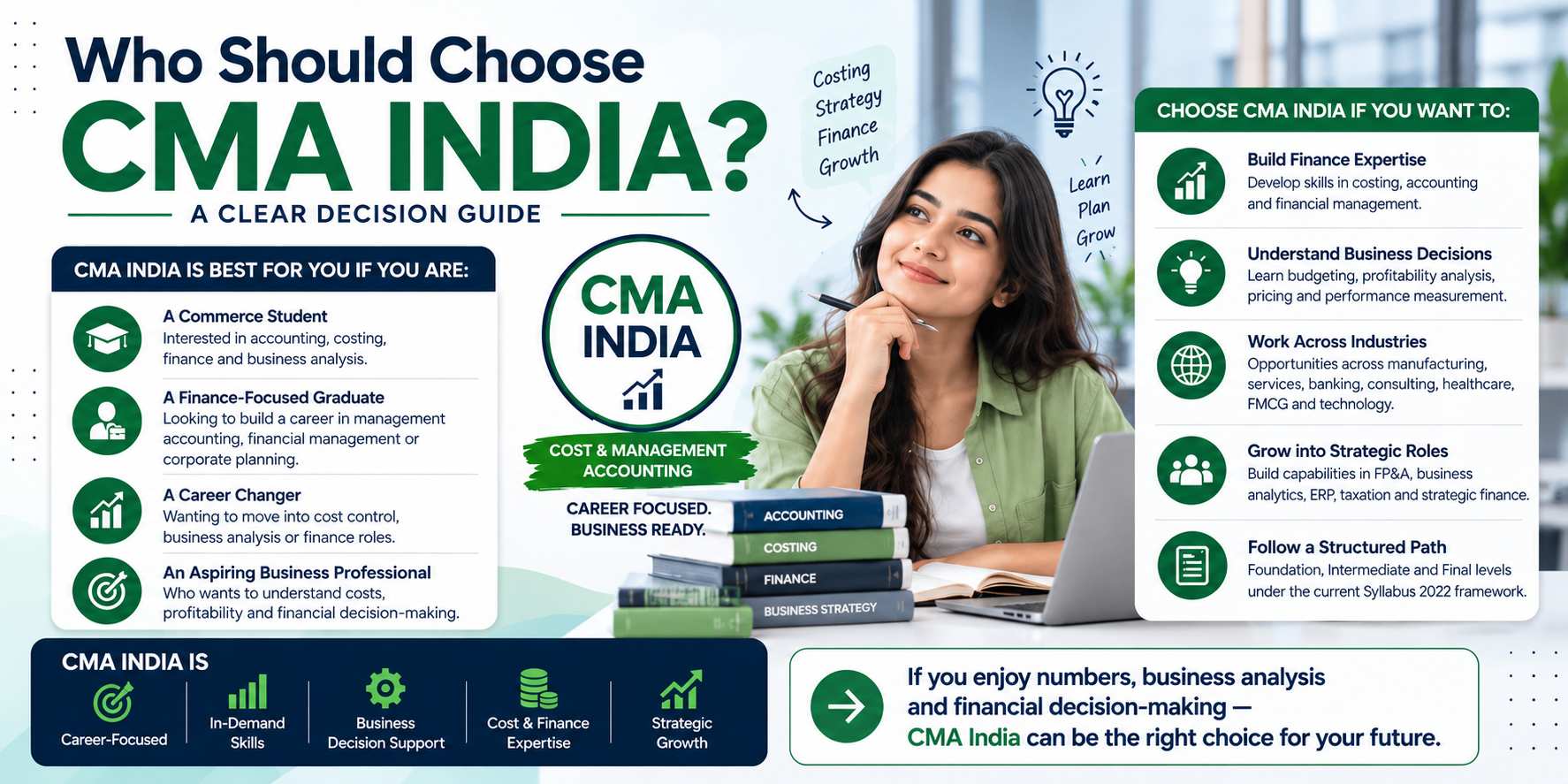
Who Should Choose CMA USA? A Clear Decision Guide
CMA USA

Who Should Choose CMA USA? A Clear Decision Guide

Choosing a professional course is less about what is popular and more about what fits your career direction. Many students look at CMA USA because it promises global exposure and strong roles in corporate finance. But the real question is simple: Is it the right fit for you?

The CMA USA program by the Institute of Management Accountants is designed for a specific type of learner and career path. This guide will help you decide where you fit.


If you want to move beyond traditional accounting


If your interest is limited to bookkeeping, auditing, or compliance-based roles, CMA USA may not align perfectly.

However, if you are interested in:

  • understanding how businesses make financial decisions
  • analysing costs and improving profitability
  • working closely with management teams

then CMA USA becomes highly relevant. It focuses on using numbers for decisions, not just reporting them.


If you are interested in corporate finance roles


CMA USA is best suited for roles inside organisations rather than external advisory roles.

It fits well if you aim for:

  • financial planning and analysis (FP&A)
  • business finance
  • cost management
  • budgeting and forecasting

These roles require you to understand business operations along with finance.


If you prefer application over theory


Some students enjoy structured theory and legal frameworks. Others prefer solving practical problems.

CMA USA is ideal for those who:

  • like case-based learning
  • enjoy analysing real business scenarios
  • prefer applying concepts rather than memorising them

If you learn better by doing rather than reading, this course will suit your style.


If you want a global career perspective


CMA USA follows a globally relevant curriculum. It is particularly useful if you plan to work in:

  • multinational companies
  • shared service centres
  • global finance teams

If your goal is to work in environments where finance decisions impact multiple markets, CMA USA supports that path.


If you are a working professional


CMA USA is often chosen by individuals who are already working.

It works well if you:

  • want to upskill without leaving your job
  • are looking to move into better finance roles
  • want to shift from accounting to business finance

The structure of the program allows you to prepare alongside work with proper planning.


If you want faster career alignment


Some professional courses take longer and are broader in scope.

CMA USA is more focused and can be completed relatively faster. It directly aligns with corporate roles, which helps in:

  • quicker role transition
  • early application of concepts
  • faster career progression

This makes it suitable for those who want a targeted career path.


If you are willing to build skills alongside the course


CMA USA gives you conceptual clarity, but career growth depends on how you apply it.

You should consider this course if you are ready to also work on:

  • financial modelling basics
  • Excel and data handling
  • communication and presentation skills

The combination of certification and skills is what creates strong career outcomes.


Who may want to reconsider CMA USA


CMA USA may not be the best fit if:

  • you are focused on audit, taxation, or compliance-heavy careers
  • you prefer purely theoretical learning
  • you are not interested in business decision-making roles

In such cases, other qualifications might align better with your goals.


A simple way to decide


Ask yourself one question:

Do I want to analyse business performance and contribute to decisions, or do I want to focus on reporting and compliance?

If your answer leans toward analysis and decision-making, CMA USA is a strong fit.

CMA USA is not for everyone, and that is exactly why it creates value. It is designed for students and professionals who want to move into roles where finance supports business strategy.

If your goals align with corporate finance, decision-making, and global exposure, CMA USA can be a practical and focused pathway. The key is choosing it with clarity, not just following trends.


April 30, 2026
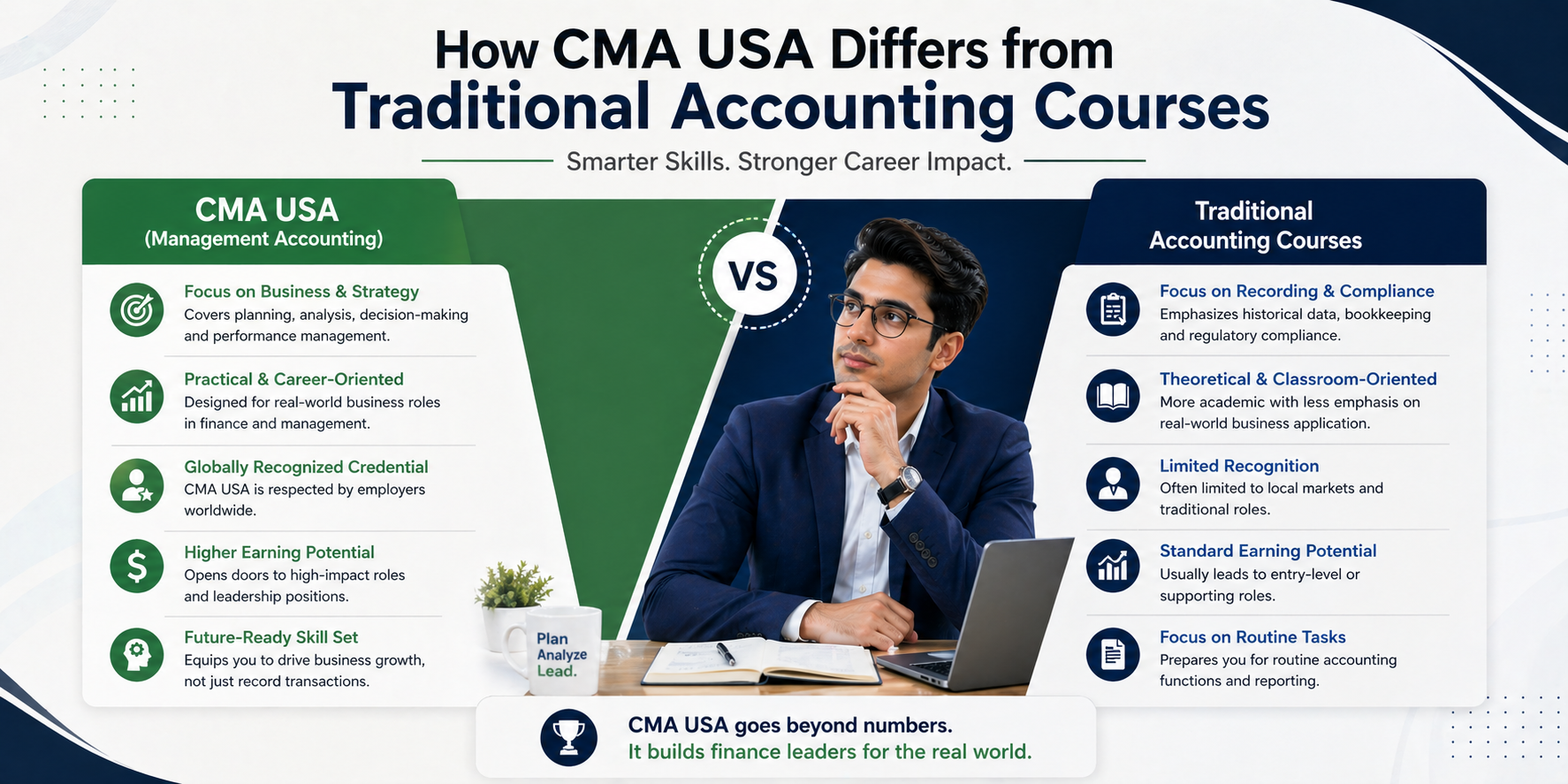
How CMA USA Differs from Traditional Accounting Courses
CMA USA

How CMA USA Differs from Traditional Accounting Courses

Many students step into accounting thinking it is only about bookkeeping, compliance, and preparing financial statements. That view comes largely from traditional accounting courses. But modern businesses expect more than record-keeping. They need professionals who can interpret numbers and guide decisions.

This is where the Institute of Management Accountants and its CMA USA program stand apart. It shifts the focus from reporting what has happened to helping decide what should happen next.


Focus: reporting vs decision-making


Traditional accounting courses are largely built around financial reporting, auditing, and taxation. The emphasis is on accuracy, compliance, and adherence to standards.

CMA USA, on the other hand, focuses on management accounting. It trains you to use financial data for planning, budgeting, and strategic decisions.

In simple terms:

  • Traditional courses explain what the numbers are
  • CMA USA explains what the numbers mean and what to do with them


Approach to learning


Most traditional programs rely heavily on theoretical understanding and structured problem-solving. Students often learn formats, standards, and procedures.

CMA USA follows a more application-driven approach. The focus is on:

  • analysing business scenarios
  • interpreting financial data
  • solving practical problems

This makes the learning more aligned with real corporate situations.


Skill development


Traditional accounting builds strong fundamentals in areas like bookkeeping, auditing, and taxation. These are essential, but often limited to specific functions.

CMA USA expands the skill set to include:

  • financial planning and analysis
  • cost management
  • performance evaluation
  • strategic thinking

These skills are directly used in decision-making roles within organisations.


Career orientation


Traditional accounting courses often lead to roles such as:

  • auditor
  • tax consultant
  • accountant

CMA USA is more aligned with roles inside organisations where finance supports business strategy, such as:

  • financial analyst
  • FP&A professional
  • cost analyst
  • business finance manager

The difference lies in the nature of work. One focuses on compliance, the other on business decisions.


Global vs local relevance


Traditional accounting courses are often structured around local regulations and standards. This makes them highly relevant within a specific country.

CMA USA follows a global framework. The concepts are applicable across industries and geographies, especially in multinational companies.

This global orientation makes it suitable for professionals aiming to work in international environments.


Use of data in decision-making


In traditional accounting, data is recorded and reported.

In CMA USA, data is analysed to support decisions.

You learn how to:

  • interpret trends
  • evaluate performance
  • support strategic planning

This shift from recording to analysing is one of the biggest differences.


Exam structure and testing style


Traditional exams often focus on:

  • theoretical questions
  • standard problem-solving formats

CMA USA exams are designed to test:

  • application of concepts
  • analytical ability
  • decision-making skills

This prepares candidates for real-world challenges rather than just exam performance.


Work environment alignment


The modern corporate environment expects finance professionals to work closely with management teams.

CMA USA prepares you for this by focusing on:

  • budgeting and forecasting
  • business strategy
  • performance management

Traditional accounting roles may operate more independently, focusing on compliance and reporting functions.

CMA USA and traditional accounting courses serve different purposes. Both are valuable, but they prepare you for different roles.

Traditional accounting builds strong compliance and reporting skills. CMA USA builds the ability to analyse, interpret, and contribute to business decisions.

For students who want to move beyond numbers and play an active role in how businesses grow, CMA USA offers a more dynamic and forward-looking approach.


April 30, 2026
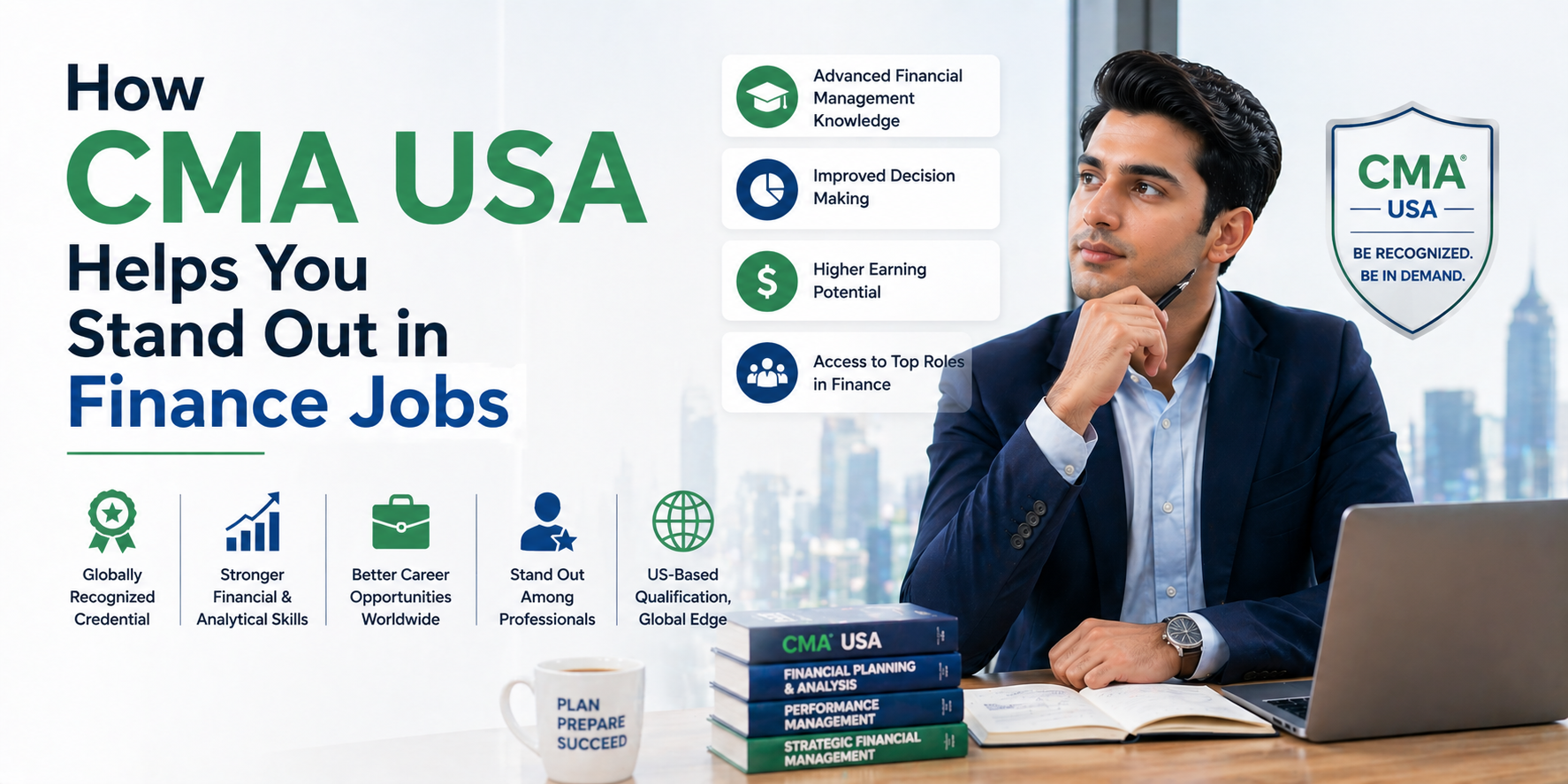
How CMA USA Helps You Stand Out in Finance Jobs
CMA USA

How CMA USA Helps You Stand Out in Finance Jobs

In today’s finance job market, having a degree is no longer enough. Employers are not just looking for candidates who understand numbers, but for those who can use numbers to drive decisions.

This is where the Institute of Management Accountants and the CMA USA qualification create a clear edge. It positions you not just as an accountant, but as a professional who can contribute to business strategy.


Shifting from accounting to business thinking


Many candidates applying for finance roles have similar academic backgrounds. What differentiates you is how you think.

CMA USA trains you to:

  • analyse business performance
  • understand cost behaviour
  • support strategic decisions

This makes you more than someone who prepares reports. You become someone who can explain what those reports mean for the business.


Building decision-making skills


One of the biggest advantages of CMA USA is its focus on decision-making.

Instead of only learning concepts, you learn how to apply them in situations like:

  • pricing decisions
  • budgeting and forecasting
  • cost optimisation

Employers value candidates who can think through problems and suggest solutions, not just identify issues.


Strong relevance in corporate roles


CMA USA aligns closely with roles inside organisations where finance teams work directly with management.

This includes areas like:

  • financial planning and analysis (FP&A)
  • business finance
  • cost management
  • performance evaluation

These roles are critical because they influence how companies plan and grow. Having CMA USA signals that you are prepared for such responsibilities.


Application-based knowledge


A common gap in many candidates is the ability to apply what they have studied.

CMA USA reduces this gap by focusing on:

  • real-world scenarios
  • case-based learning
  • analytical problem-solving

This makes you more confident during interviews and better prepared for actual job responsibilities.


Global perspective


Modern companies often operate across multiple countries. They look for professionals who understand global business environments.

CMA USA provides a broader perspective by covering concepts that are relevant internationally. This makes your profile attractive to multinational companies and global teams.


Better alignment with employer expectations


Employers today expect finance professionals to contribute beyond routine tasks.

They look for candidates who can:

  • interpret financial data
  • communicate insights clearly
  • support business decisions

CMA USA directly builds these capabilities, which helps you match what employers are actually looking for.


Improved interview performance


Many candidates struggle in interviews, not because they lack knowledge, but because they cannot connect concepts to real situations.

With CMA USA, you are better equipped to:

  • explain financial concepts in practical terms
  • discuss business scenarios confidently
  • demonstrate structured thinking

This improves your chances of converting interviews into job offers.


Standing out in a competitive pool


When multiple candidates apply for the same role, small differences matter.

CMA USA helps you stand out because it signals:

  • commitment to a finance career
  • specialised knowledge in management accounting
  • readiness for corporate roles

It gives recruiters a reason to shortlist your profile among many similar applications.

CMA USA helps you stand out not by adding another qualification to your resume, but by changing how you approach finance.

It builds skills that are directly relevant to modern business roles. It prepares you to think, analyse, and contribute.

In a competitive job market, that difference is what sets you apart.


April 30, 2026
CFA in Investment Banking: What to Expect
CFA

CFA in Investment Banking: What to Expect

Investment banking is often seen as one of the most demanding yet rewarding careers in finance. High-pressure deals, long hours, and steep learning curves define the role. Naturally, many students pursuing the CFA Institute wonder how well the CFA program fits into this space.

The short answer is this: CFA can support your journey into investment banking, but it is not a direct ticket. What it does is build a strong foundation that becomes valuable once you are in the role.


How relevant is CFA for investment banking?


Investment banking revolves around:

  • valuation of companies
  • financial modelling
  • mergers and acquisitions
  • capital raising

CFA covers several of these areas, especially valuation, financial reporting, and corporate finance. This makes it relevant, but not sufficient on its own.

Investment banks typically prioritise candidates who combine:

  • strong academic background
  • practical skills
  • internships or relevant exposure

CFA adds credibility, but it works best as a supporting qualification.


What CFA actually prepares you for


CFA builds a solid understanding of financial concepts that are directly used in investment banking.

You develop:

  • clarity in reading financial statements
  • understanding of valuation techniques
  • knowledge of capital markets
  • awareness of risk and return dynamics

This helps you understand the logic behind deals rather than just executing tasks.


Where CFA helps in getting into investment banking


CFA can strengthen your profile in the early stages of your career.

It helps in:

  • demonstrating commitment to finance
  • improving your chances of shortlisting
  • building confidence during technical interviews

For candidates without a finance-heavy background, CFA can act as a strong signal of seriousness toward the field.


Is CFA alone enough?


This is where expectations need to be clear.

Investment banking is highly competitive. Firms usually look beyond certifications.

CFA alone may not be enough if you lack:

  • financial modelling skills
  • Excel proficiency
  • deal or internship experience

Recruiters expect candidates to apply concepts in real-world scenarios, not just understand them theoretically.


Typical roles you can expect


With CFA (especially Level I or II), candidates usually enter at junior levels such as:

  • Investment Banking Analyst
  • Supporting deal execution, preparing presentations, and building models
  • Financial Analyst
  • Working on data analysis and company evaluation
  • Research Associate
  • Assisting in industry and company research

These roles involve long hours and steep learning, but they provide strong exposure to the industry.


Skills you need alongside CFA

To move into investment banking, CFA should be combined with practical skills.

Focus on developing:

  • Financial modelling
  • Advanced Excel
  • Valuation techniques
  • Presentation and communication skills

Internships play a crucial role here. Even short-term experience can significantly improve your chances.


Work environment and expectations


Investment banking is known for its intensity.

You can expect:

  • Long working hours
  • tight deadlines
  • High attention to detail
  • Fast-paced learning

CFA helps you understand the work, but adapting to the environment requires discipline and resilience.

Once you enter investment banking, growth depends on performance and experience.

With time, professionals move into roles such as:

  • Associate
  • Vice President
  • Director

CFA becomes more valuable at higher levels, especially in roles involving decision-making and strategy.

Consider two candidates applying for an investment banking role. One has cleared CFA Level I but has no practical exposure.

The other has basic financial modelling skills and internship experience along with CFA Level I.

The second candidate is more likely to be selected. The difference lies in application, not just qualification.

CFA is relevant for investment banking, but it is not a standalone solution. It strengthens your understanding of finance and adds credibility to your profile.

To convert it into a career opportunity, you need to complement it with practical skills, internships, and consistent effort.

Think of CFA as a strong foundation. Investment banking requires you to build on that foundation with real-world experience and execution skills.


April 30, 2026
Job Opportunities for CFA in India and Abroad (2026 Guide)
CFA

Job Opportunities for CFA in India and Abroad (2026 Guide)

A finance career today is no longer limited by geography. A professional sitting in Mumbai can analyse a US company, track global markets, and work with international clients. This shift has increased the demand for qualifications that are globally relevant.

The CFA Institute offers one such qualification. The CFA program is designed to build strong foundations in investment analysis, portfolio management, and financial decision-making. But the real question students ask is simple: What opportunities does CFA actually open up?


Why CFA holds strong career value


The CFA charter is respected across financial markets because of its focus on depth and application. It trains candidates to understand investments, evaluate risks, and make informed decisions.

This relevance makes CFA valuable in roles where:

  • financial analysis is critical
  • investment decisions matter
  • data interpretation drives outcomes

Employers recognise the effort and discipline required to clear CFA levels, which adds credibility to your profile.


Scope of CFA in India


India’s financial ecosystem has grown significantly over the last decade. With increasing participation in capital markets, mutual funds, and fintech platforms, the need for skilled finance professionals has expanded.

CFA fits well into this ecosystem because it builds expertise in areas such as valuation, portfolio management, and risk assessment.


Key sectors hiring CFA candidates in India


  • Investment banking firms
  • Roles in fundraising, mergers, and corporate finance
  • Asset management companies and mutual funds
  • Managing investments and analysing market opportunities
  • Equity research firms
  • Evaluating stocks and preparing research reports
  • Wealth management firms
  • Advising clients on investments and financial planning
  • Fintech companies
  • Working on data-driven financial products and platforms

Indian markets are becoming more structured and data-driven. This increases the demand for professionals who can interpret financial information effectively.


Scope of CFA abroad


One of the strongest advantages of CFA is its global acceptance. The curriculum is aligned with international financial practices, making it relevant across markets.

CFA professionals are in demand in global financial hubs such as:

  • the United States
  • the United Kingdom
  • the UAE
  • Singapore
  • Canada

Key global sectors hiring CFA professionals


  • Investment banks and financial institutions
  • Hedge funds and asset managers
  • Consulting and advisory firms
  • Pension funds and sovereign wealth funds

The global scope of CFA allows professionals to explore roles beyond domestic markets, provided they have the required skills and experience.


Top job roles after CFA


CFA does not limit you to a single career path. It opens up multiple roles within finance and investment domains.

Some of the most relevant roles include:

  • Equity Research Analyst
  • Analysing companies, industries, and market trends
  • Portfolio Manager
  • Managing investment portfolios for clients or institutions
  • Investment Banking Analyst
  • Supporting deals related to mergers, acquisitions, and fundraising
  • Risk Analyst
  • Assessing financial risks and suggesting mitigation strategies
  • Wealth Manager
  • Advising individuals on investments and financial planning
  • Private Equity Analyst
  • Evaluating investment opportunities in private companies

Each role requires a mix of technical knowledge and practical exposure. CFA provides the foundation, while experience builds expertise.


Salary expectations in India


Salaries for CFA candidates in India vary based on experience, role, and organisation.

  • Entry-level (0–2 years)
  • Roles such as research analyst or junior financial analyst
  • Approximate range: ₹7–12 LPA
  • Mid-level (3–5 years)
  • Roles such as senior analyst or risk manager
  • Approximate range: ₹12–25 LPA
  • Senior-level (7+ years)
  • Roles such as portfolio manager or leadership positions
  • Approximate range: ₹25 LPA and above

Growth in salary is closely linked to skills, performance, and domain expertise.


Salary trends abroad


In international markets, compensation is generally higher due to the scale and maturity of financial industries.

  • In major financial hubs like the US and UK, finance roles can offer $80,000 to $200,000 annually, depending on experience
  • In regions like Singapore and the UAE, experienced professionals often earn six-figure salaries

These figures vary widely based on role, firm, and individual performance.


What matters beyond the CFA qualification


While CFA adds strong value, it is not a standalone guarantee for high-paying roles. Employers also look for:

  • practical exposure through internships or work experience
  • strong analytical and problem-solving ability
  • communication and presentation skills
  • familiarity with tools such as Excel and financial models

Candidates who combine CFA with these skills are better positioned in the job market.


What to do after completing CFA


Finishing the CFA program is a major milestone, but career growth depends on how you apply it.

A practical approach includes:

  • Gaining relevant work experience
  • Entry-level roles help in applying concepts in real scenarios
  • Building technical skills
  • Financial modelling, data analysis, and valuation techniques
  • Networking within the industry
  • Connecting with professionals and attending finance events
  • Considering complementary certifications
  • Courses like FRM can strengthen specialised areas


The CFA program offers a wide career scope in both India and global markets. It builds skills that are relevant across investment roles, financial analysis, and strategic decision-making.

For students aiming to build a career in finance with global exposure, CFA provides a structured and respected pathway. However, its true value comes when knowledge is combined with practical experience and consistent skill development.

In the end, CFA is not just about passing exams. It is about becoming a professional who can understand markets, analyse opportunities, and contribute meaningfully in the world of finance.


April 30, 2026
How CFA Helps You Understand Stock Markets Better
CFA

How CFA Helps You Understand Stock Markets Better

Many people enter the stock market with curiosity. They track prices, follow news, and try to predict movements. But without a structured understanding, the market often feels unpredictable.

This is where the CFA Institute plays a significant role. The CFA program does not teach you how to “guess” the market. It teaches you how to understand it.


Moving from price watching to analysis


Most beginners focus on stock prices. If a stock goes up, it seems good. If it falls, it feels risky.

CFA changes this perspective. Instead of asking “What is the price?”, you start asking:

  • Why is the price moving?
  • Is the stock overvalued or undervalued?
  • What factors are driving this change?

This shift from observation to analysis is the first major step in understanding markets.


Understanding financial statements


Stock prices are influenced by company performance. CFA trains you to read and interpret financial statements such as:

  • income statement
  • balance sheet
  • cash flow statement

You learn how to evaluate profitability, liquidity, and financial health.

Instead of relying on tips or opinions, you begin forming your own view based on data.


Learning valuation techniques


One of the most important skills CFA develops is valuation.

You learn how to estimate what a stock is actually worth using methods like:

  • discounted cash flow (DCF)
  • relative valuation (P/E, EV/EBITDA)

This helps answer a critical question:

Is this stock worth buying at its current price?

Understanding valuation reduces dependence on market noise.


Connecting macroeconomics with markets


Stock markets do not move in isolation. They are influenced by economic factors such as:

  • interest rates
  • inflation
  • GDP growth
  • government policies

CFA builds a strong foundation in economics, helping you understand how these factors impact markets.

For example, rising interest rates may affect stock valuations. With this knowledge, market movements start making more sense.


Understanding different asset classes


The stock market is just one part of the financial ecosystem.

CFA introduces you to multiple asset classes, including:

  • equities
  • fixed income
  • derivatives
  • alternative investments

This broader perspective helps you understand how money flows between markets and why certain assets perform better under specific conditions.


Risk and return awareness


One of the biggest mistakes beginners make is focusing only on returns.

CFA teaches you to look at risk alongside returns. You learn concepts such as:

  • risk diversification
  • portfolio allocation
  • volatility

This helps in building a balanced approach rather than chasing short-term gains.


Developing a structured approach to investing


Without a framework, investing often becomes emotional. Decisions are driven by fear or excitement.

CFA introduces a structured approach:

  • analyse the company
  • evaluate valuation
  • consider economic conditions
  • assess risks

This process reduces impulsive decisions and improves consistency.


Understanding market behaviour


Markets are influenced not just by data, but also by human behaviour.

CFA touches on behavioral finance, helping you understand:

  • why investors panic
  • how herd mentality works
  • why markets sometimes act irrationally

Recognising these patterns helps you stay rational when others are not.


From short-term thinking to long-term perspective


Many beginners focus on quick profits.

CFA encourages a long-term view. You start looking at:

  • business fundamentals
  • sustainable growth
  • long-term value creation

This mindset aligns more closely with how professional investors approach markets.

Consider a stock that suddenly drops in price. A beginner may react emotionally and sell. Someone with CFA knowledge would ask:

  • Has the company’s performance changed?
  • Is the drop due to market sentiment or real issues?
  • Does this create a buying opportunity?

The reaction changes because the understanding is deeper. CFA does not make the stock market predictable. No course can do that.

What it does is make the market understandable. It gives you the tools to analyse, question, and interpret what is happening.

Over time, this transforms how you look at investing. You move from reacting to movements to understanding the reasons behind them.

And that is what truly helps you navigate the stock market better.


April 30, 2026
Does CFA Level 1 Help You Get a Job? A Realistic Look
CFA

Does CFA Level 1 Help You Get a Job? A Realistic Look

Introduction

Clearing Level I of the CFA Institute feels like a solid milestone. After months of preparation, one question naturally follows: Will this help me get a job?

The honest answer is not a simple yes or no. CFA Level I can open doors, but it does not guarantee entry. What it does offer is a strong signal to employers that you are serious about a career in finance and have built a foundation to start from.


What CFA Level I actually represents


CFA Level I focuses on building core knowledge in:

  • financial reporting and analysis
  • equity and fixed income basics
  • corporate finance
  • portfolio management fundamentals

Clearing it shows that you understand how financial markets work at a conceptual level. It also signals discipline, consistency, and the ability to handle a rigorous exam.

However, employers do not hire based on knowledge alone. They look for application, skills, and readiness for the role.


Can you get a job after CFA Level I?


Yes, you can. But the kind of job you get depends on what else you bring to the table.

CFA Level I strengthens your profile, especially for entry-level roles such as:

  • equity research analyst (junior roles)
  • financial analyst
  • investment research associate
  • roles in KPOs and financial services firms

These roles usually involve supporting senior professionals, working with data, and building basic financial understanding.


Where CFA Level I helps the most


CFA Level I is particularly useful in getting shortlisted. It adds credibility to your resume, especially if you do not have a finance-heavy academic background.

It helps in:

  • standing out in competitive applicant pools
  • showing commitment to finance careers
  • building basic interview confidence

For many recruiters, it acts as a filter that indicates seriousness toward the field.


Where CFA Level I alone falls short


This is where expectations need to be realistic.

CFA Level I alone may not be enough if:

  • you have no practical exposure
  • you lack communication or analytical skills
  • your resume does not reflect relevant experience

Employers expect candidates to apply what they have learned. Without that, the qualification becomes theoretical.


What recruiters actually look for


In most finance roles, employers evaluate a combination of factors:

  • Conceptual clarity
  • Basic understanding of finance concepts is expected
  • Practical exposure
  • Internships, projects, or any real-world experience
  • Analytical ability
  • Ability to interpret data and think logically
  • Communication skills
  • Clear explanation of ideas and insights

CFA Level I supports the first part. The rest needs to be developed alongside.


How to improve your chances after Level I


To convert CFA Level I into a job opportunity, focus on building a complete profile.

Start by strengthening practical exposure. Even small internships or freelance projects in finance can make a difference. They show that you have seen how concepts work outside textbooks.

Work on financial skills such as:

  • basic financial modeling
  • Excel proficiency
  • understanding of company reports

At the same time, improve how you present your knowledge. Interviews often test how well you can explain concepts in simple terms.


A realistic example


Consider two candidates who have cleared CFA Level I.

One has only the qualification.

The other has the same qualification along with an internship, basic Excel skills, and the ability to discuss a company’s financials.

The second candidate is more likely to get selected. Not because of the certification alone, but because of how it is supported by practical skills.


Does CFA Level I guarantee a high-paying job?


No, it does not.

At the entry level, salaries depend on:

  • your overall profile
  • the role you apply for
  • the company and location

CFA Level I helps in getting started, but growth depends on experience, performance, and continued learning.


Long-term value of CFA Level I


While Level I may not guarantee immediate results, it builds a strong base for the future.

As you progress to Level II and Level III, the value of the qualification increases significantly. Combined with work experience, it can lead to roles in:

  • portfolio management
  • equity research
  • investment banking
  • asset management

Level I is the starting point, not the final outcome.

CFA Level I does help in getting a job, but not on its own. It improves your profile, increases visibility, and shows intent.

To convert it into real opportunities, you need to complement it with practical exposure, skills, and clear communication.

Think of CFA Level I as a strong foundation. What you build on top of it determines how far your career goes.


April 30, 2026